CSUB reduces offshore installation cost, vessel requirements and lifecycle risk with certified, custom-engineered GRP subsea structures. 50–70% lighter than steel. 50+ year design life. Proven across 500+ deliveries worldwide.
What if your subsea support structures could be installed with smaller cranes, fewer vessel campaigns, and better deck utilisation — and then deliver 50+ years of performance with no corrosion-related maintenance burden?
That is what CSUB delivers. For three decades, we have been engineering and fabricating Glass Fiber Reinforced Polymer (GRP) subsea structures that reduce total installed cost and lower lifecycle risk for offshore operators and EPCI contractors worldwide.
From the Norwegian Continental Shelf to the Middle East, from West Africa to South America, CSUB has completed more than 500 deliveries. We continue to grow alongside our clients wherever subsea activity is accelerating.
Less Vessel, Less Crane, Less Cost
The single largest cost driver in many subsea infrastructure projects is not the structure itself — it is the installation. Vessel day rates, crane capacity requirements, the number of campaigns needed, and deck space utilisation determine whether a project stays on budget.
This is where GRP changes the equation.
50–70% weight reduction:
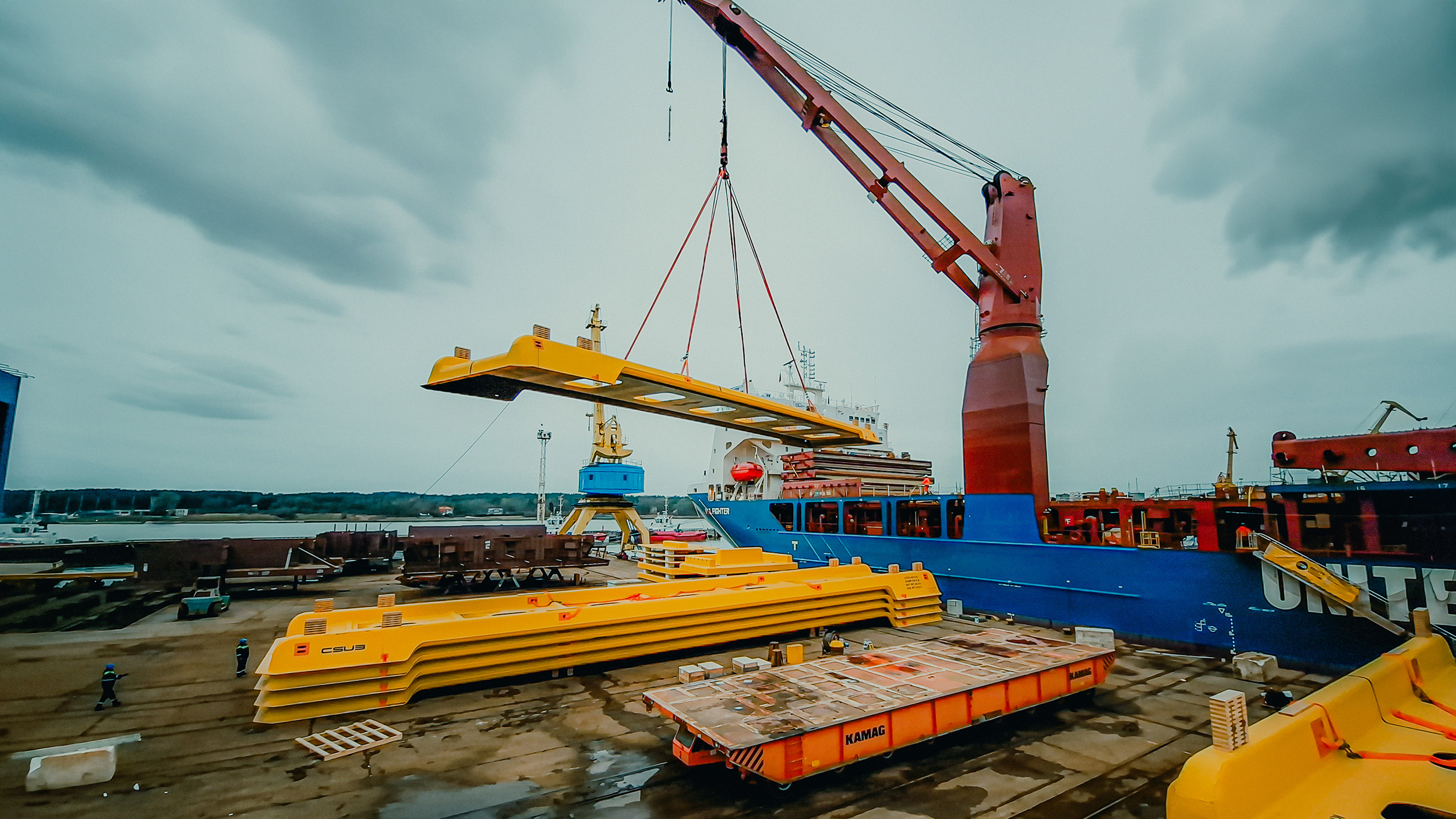
GRP has a specific gravity of approximately 2.0 — compared with steel at around 7.8. Depending on the structure and application, a subsea crossing, sleeper or support structure in GRP is 50–70% lighter than a steel alternative. That lower weight reduces crane demand, simplifies offshore handling and expands vessel flexibility.
Stackable design:
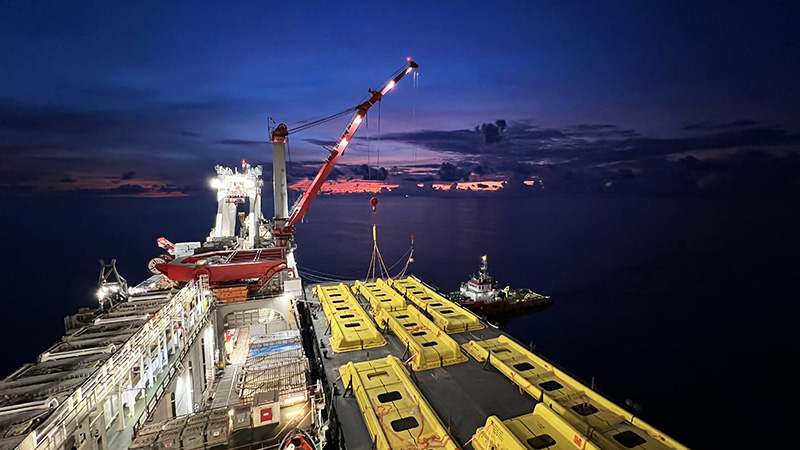
CSUB structures are designed to stack efficiently. Where a vessel deck might carry 15–20 steel structures, it can carry significantly more GRP equivalents. That improves deck utilisation, reduces load-out frequency and can reduce the number of offshore installation campaigns required.
Simplified handling:
Lower weight means smaller cranes, simpler rigging and faster lift cycles. In deepwater operations, where heavy-lift vessel day rates can exceed USD 200,000, these savings can scale quickly across a campaign.
The global subsea market is experiencing strong investment growth, with deepwater and ultra-deepwater projects accounting for a large share of new spending. (Source: Rystad Energy, 2024)
Designed for Long Service Life with Reduced Lifecycle Burden
A steel subsea structure begins accumulating corrosion risk the moment it enters service. Cathodic protection, coating maintenance, anodes, inspection planning and future intervention requirements all add lifecycle cost and operational complexity.
CSUB’s GRP structures are designed for 50+ years of service life. The material is not subject to metallic corrosion, requires no cathodic protection for the composite structure, and helps remove a major share of the corrosion-related lifecycle burden associated with metallic alternatives.
When reduced shipping, simpler installation and lower corrosion-related lifecycle burden are considered together, the total cost of ownership comparison becomes compelling.
— When you factor in the reduced shipping, simpler installation, and lower lifecycle burden over a 50+ year service life, the total cost of ownership comparison is compelling, says Anders Holm, CEO of CSUB.
H₂S Resistance: Where Steel Faces Greater Risk
Hydrogen sulfide (H₂S) is one of the most destructive corrosion agents in the oil and gas industry, contributing to sulfide stress cracking (SSC), hydrogen-induced cracking (HIC), and accelerated degradation in carbon steel. Many of the world’s remaining hydrocarbon reserves are increasingly sour, with high H₂S concentrations present across the Middle East, Southeast Asia and deepwater basins globally.
GRP offers a non-metallic alternative that is not vulnerable to these metallic corrosion mechanisms. There is no sulfide stress cracking, no hydrogen embrittlement and no corrosion-driven degradation in the way steel structures can experience in sour environments. For operators, that means GRP can provide a more robust long-life option in applications where corrosion resistance and long-term subsea durability are critical.
For steel structures in sour environments, operators may have to specify sour-service alloys or accept higher inspection and replacement risk over time. GRP removes much of that dilemma.
Trusted by the Industry’s Biggest Players
CSUB has completed 500+ deliveries to projects across multiple offshore basins worldwide.
Leading EPCI contractors including Subsea7, TechnipFMC, Saipem, Ocean Installer and McDermott have specified CSUB GRP structures. CSUB also maintains frame agreements and long-term relationships with key clients.
CSUB structures are developed with reference to recognised industry frameworks and project requirements, including DNV-ST-C501, DNV-GL-RP-F109, DNV-GL-RP-F111 and NORSOK U-001 where applicable.
Impact performance has been tested up to 800 kJ, including SINTEF-validated trawl testing, helping demonstrate suitability for demanding subsea support and protection applications.
Co-Engineering and Responsiveness
Every CSUB structure is custom-designed for its specific project requirements. Our engineering department — the largest in Norway dedicated to GRP composite structures — works directly with clients on design optimisation, value engineering and fast-track delivery.
Lead times can range from as little as 5 days for selected simpler structures to 4–6 weeks for more complex custom-engineered solutions. This responsiveness is especially valuable for EPCI contractors managing tight schedules and evolving project requirements.
GRP production requires approximately one sixth of the floor area of steel or concrete fabrication, with no curing time constraints. For clients, that translates directly into shorter lead times and greater flexibility to accommodate late-stage design changes or accelerated schedules.
Global Footprint, Growing With Our Clients
CSUB operates from its engineering headquarters in Norway, with manufacturing capacity across multiple sites. Our production partnership with Qatar Shipyard Technology Solutions in Doha has demonstrated how local manufacturing can reduce transport costs, shorten delivery times and improve local-content performance.
This model of working with regional partners provides a template that can be adapted to serve clients wherever they operate.
Designed for the Future of Subsea Inspection
CSUB is also developing sensor-integrated and drone-ready subsea covers in collaboration with technology partners, linking structural performance with the future of unmanned subsea inspection and monitoring.
This capability builds on CSUB’s proven GRP platform, extending structural performance into the next generation of offshore field architectures.
GRP vs. Steel vs. Concrete
| Parameter |
CSUB GRP |
Steel |
Concrete |
| Installation weight |
50-70% lighter (SG ≈2.0) |
Baseline (SG ≈7.8) |
Much heavier per structure |
| Vessel/crane requirements |
Smaller vessels, lighter cranes |
Heavy-lift required |
Heavy-lift required |
| Deck utilisation |
Highly stackable |
Limited stacking |
Not stackable |
| Design life |
50+ years |
20-30 years* |
25-40 years |
| Maintenance required |
None |
CP, coatings, anodes, inspection |
Periodic inspection |
| H₂S / Sour service |
Immune — no special requirements |
Requires sour-rated alloys |
Not applicable |
| Corrosion resistance |
Immune |
Corrodes; H₂S causes SSC/HIC |
Chloride penetration |
| Lead time |
5 days to 4-6 weeks |
8-16 weeks |
12-20 weeks |
| Production footprint |
≈1/6 of steel/concrete area |
Large workshop |
Very large curing area |
| CO₂ footprint |
Significantly lower |
High |
Very high |
| Impact resistance |
Tested up to 800 kJ |
Varies |
Low energy absorption |
* In aggressive subsea environments without extensive cathodic protection programs.
Product Portfolio
CSUB’s product range covers the most common subsea support and protection applications, each custom-designed:
| Product |
Application |
Installation advantage |
Lifecycle advantage |
| Pipeline Sleepers & Buckling Initiators |
Support and controlled thermal buckling |
50-70% lighter. Stackable. Fewer trips. |
H₂S immune. Zero maintenance. |
| Crossings & Bridges |
Pipeline/cable crossing |
Reduced lifts. Better deck use. |
No corrosion. 50+ year life. |
| Freespan Correction |
Adjustable supports over uneven seabed |
Adjustable wedge system. |
Maintenance-free. Adapts to seabed. |
| Foundations |
Mudmats for subsea equipment |
Lightweight. CFD-designed. |
All soil types. No degradation. |
| Protection Covers |
Trawl/dropped object protection |
Lighter vessels possible. |
800 kJ tested. SINTEF validated. |
| J-Tube Ramps |
Cable-to-platform connections |
Self-stabilising. Simpler install. |
Custom-fit. Zero maintenance. |
| Cable Protection |
Flying lead, catenary supports |
Stackable. Pre-rigged. |
Compatible with covers. |
| Subsea Hatches |
XTs, manifolds, templates |
Reduces structure weight. |
Lightweight GRP alternative. |
Contact us to discuss your project requirements.